Don't build a life where the reward is 5 years away
What if you died tomorrow?
Founders and athletes share a dangerous superpower: the ability to delay gratification for years.
We all work hard for some distant goal in the future: achieving a breakthrough innovation, having a life-changing exit, competing in a major international tournament, maybe even in the Olympics.
And we make a lot of sacrifices on the way.
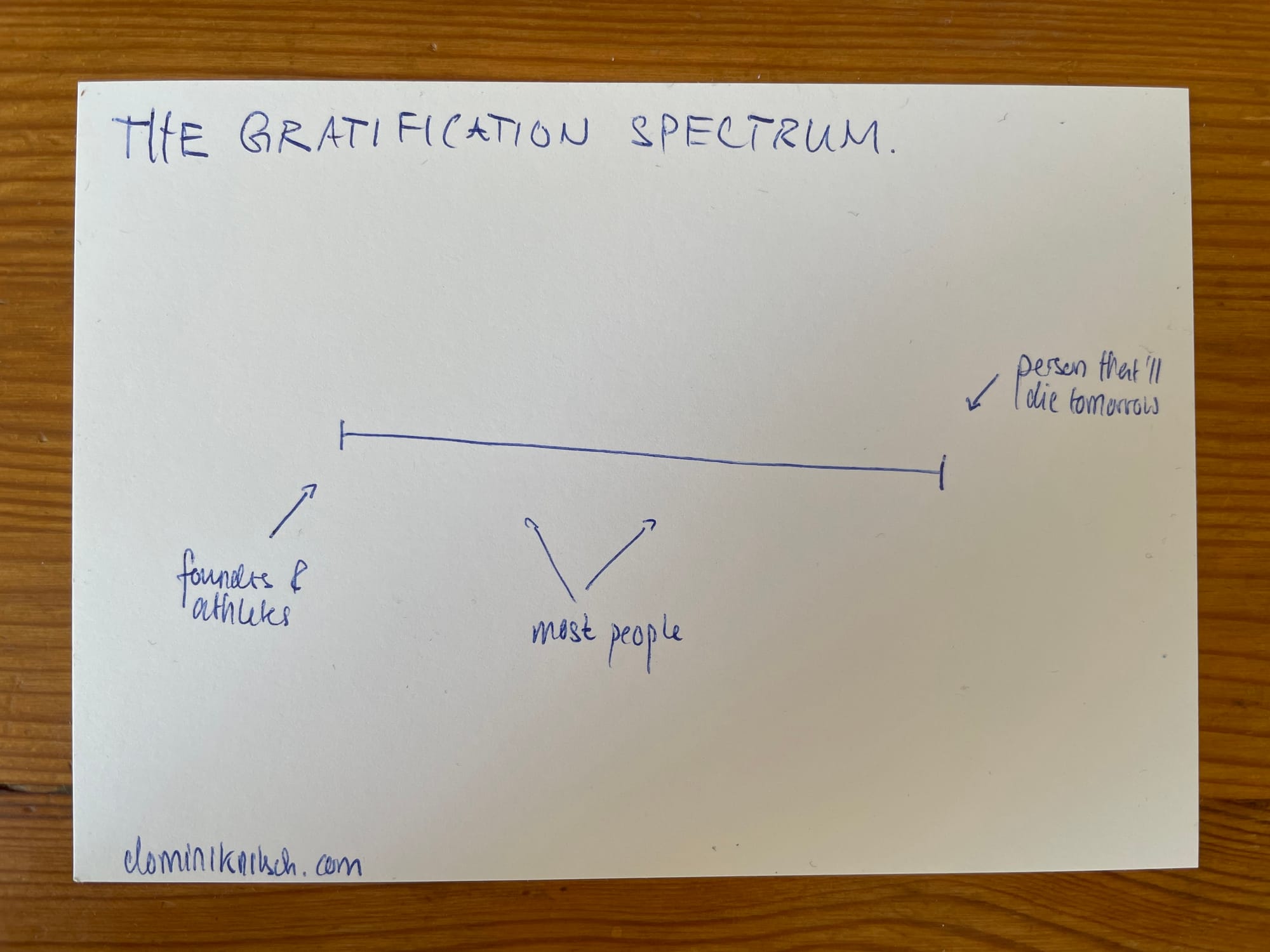
Gratification exists on a spectrum: on one end, we have the Olympic athlete or locked-in founder, who will sacrifice anything and everything in pursuit of their dream.
On the other end, we have the person that knows they’ll die tomorrow, trying to get as much gratification as humanly possible, as there’s no point in delaying it.
Looks like this:
This spectrum has implications on the life we live:
- If we always stay on the very left, we’ll never get to reap what we sowed.
- If we always stay on the very right, we’ll probably go broke and die within a few years.
Both are terrible.
For most of my career, I’ve stayed towards the left end of the spectrum:
- Not living in another country (despite my clear goal to do this again) in the last 12 years so I could continue to pursue my dream of representing Germany in Lacrosse internationally.
- Skipping a lot of holidays and breaks because of my own businesses.
- Working on weekends when everybody else was frolicking in the Berlin sun.
I told myself: “Later. After the next milestone.”
But what if I died tomorrow?
Was all this work in vain?
Am I gonna continue going down this path of delaying gratification forever, always in pursuit of the next goal?
Hell no.
The goal is not to stop delaying gratification.
The goal is to layer gratification into the delay.
Here’s what we can do:
Mini-Retirements
It’s time to bring back a classic of self-optimization literature: The Four-Hour Workweek. In the first part of the book, Tim Ferriss talks about “mini-retirements”.
The idea is simple: instead of working all your life and then doing everything “when I retire”, you simply spread those out over your career: a few months every few years.
Those retirements aren’t just meant for chilling on the beach; they’re meant for doing things that you’ve always wanted to do, without concern for your career. For example, I used my only mini-retirement so far to write a book (yet to be published) and record an online course. Ferriss learned how to dance Tango, fight Muay Thai, and speak German during his.
Instead of delaying gratification towards the end of your career, only delay it for a few years.
Working in Seasons
Jonathan Goodman argues in Unhinged Habits:
“Living a seasonal life is nothing new. Our hunter-gatherer ancestors worked hard in the spring, summer, and fall to collect food and, in the winter, subsisted mostly off their stores. They rested and, I imagine, spent more time with their family and community.
Before Edison invented the light bulb making it possible to be productive past sunset, the average person slept ten hours a night. It varied throughout the year as the seasons changed and the days got longer or shorter. Now the average person gets six to seven hours of sleep year-round.”
Athletes already follow seasonality:
- Off-Season: fix nagging injuries, build muscle mass
- Pre-Season: add speed and conditioning
- In-Season: focus on maintenance of performance, fix minor issues
- Post-Season: go all out for semi-finals and finals
What if we could implement a similar logic into our working rhythm?
Goodman follows an “8-4 cadence”: 8 months in his hometown of Toronto; 4 months in a different country, different environment, where he focuses on family, fun, and fulfillment instead of just working hard. Work just fills the gap in between; in the other 8 months, it’s the other way around.
Most businesses are seasonal anyway. In recruitment, January, September and November are the hottest months; July & August are dead.
No point in fighting it – instead, I travel a bit, focus on the “important-but-not-urgent” things, and grab an occasional beer in the afternoon during the week with friends.
Indulge Weekly
Even if you’re an absolute world champion at delaying gratification, it’s probably healthy to indulge here and there.
- Skipping your morning routine.
- Having a few more drinks than you should.
- Sleeping for an extra hour or two.
- Eating the food that you’re craving, not the one that’s specified on your nutrition plan.
As long as you keep it “once, not twice” (ie. don’t indulge several days in a row), the net effects are - in my opinion - positive. The short-term cost to your body is often repaid in long-term motivation.
Just don’t become that person that will “treat themselves” for every little thing that they’ve done, like: damn, I worked 8 hours today, I’ll take it easy tomorrow.
As a framework:
- Indulge in a few things weekly (but remember “once, not twice”)
- Add seasonality to your life
- Plan mini-retirements of 3-6 months every few years
Don’t build a life where the reward is always five years away.
If you always delay gratification, you might burn out. As Blake Scholl writes:
“Burnout is not what it presents: it’s not about working too hard for too long, burnout is about working in the face of a goal that seems too far out, too unattainable, too abstract.
Everyone has what I’ve come to call a “gratification window,” the period of time in which there must be a believable reward in order to stay motivated. As exemplified in the Marshmallow Test, kids can have notoriously short gratification windows. Founders probably have some of the longest gratification windows—willing to work years or even decades to realize a goal. Most people lie somewhere in the middle.
The principle of a gratification window applies to all of us. So long as there’s something tangible, believable and motivating within their gratification window, great people will happily work long, smart, and hard—often with remarkably little rest. When there’s nothing in the gratification window, even great people feel burned out.”
Empires are built in years, but sustained by moments.
If you burn out too early, you won’t be able to achieve what you’ve set out to achieve.
By layering in gratification consistently, you’ll be able to go for a long time.
Much longer than the guy that works 9-9-6 and has nothing else going in life.
If you're not yet subscribed, please do so. If you are, consider saying hi on the social media of your choice:
LinkedIn | Threads | X | Bluesky | Instagram | TikTok | YouTube
Whenever you're ready, there are four ways I can help you:
[1] Reclaim up to 4 hours per day and find time to do the things you've always wanted to do by enrolling into Personal Productivity OS.
[2] Hire your next Founder's Associate or other business generalist position with my startup, Generalyst Recruiting.
[3] You could also find your next startup job in Europe by simply applying as a candidate.
[4] Learn how you can build your career as a generalist by subscribing to this newsletter. ⬇️

Dominik Nitsch Newsletter
Join the newsletter to receive the latest updates in your inbox.