Generalists don't have a skills problem. They have a story problem.
How to position yourself as a generalist.
In the welcome email to my newsletter, I ask every new subscriber: "If I could dedicate one newsletter issue to you, what would it be about?"
One answer that keeps coming up, in a variety of forms: "I don't know how to position myself. I've done a lot of different things, but how do I tell a coherent story?"
I've struggled with this a lot. Hunting for jobs after my time at EF in 2020, I was constantly being asked: "what do you specialize in?"
Nothing, really. I can do a lot of things, sell enterprise contracts, build business processes, even do accounting (only if absolutely necessary though).
I'm good at figuring things out, I guess?
Needless to say, that didn't sell very well.
So this Sunday, I blocked off a few hours to do some research on the best positioning frameworks. We'll see a few familiar faces: Scott Adams, Wes Kao, April Dunford.
And we'll put that together into a five-step framework to figure out your positioning.
Let's dive in.
Part 1: Your Talent Stack.
The late Scott Adams published a simple post called "Career Advice" in 2007 (not live on the web anymore, but you can find it here). The biggest insight:
If you want something extraordinary, you have two paths:
1. Become the best at one specific thing.
2. Become very good (top 25%) at two or more things.
Path one is nearly impossible: good luck trying to make it to the sports pro leagues, or to become the most renowned physics researcher out there.
Path two is much more achievable. Just take something you're already decent at, combine it with something you're passionate about, sprinkle in a meta-skill et voilà: you have a unique talent stack that nobody else can reproduce.
Look at this graphic:
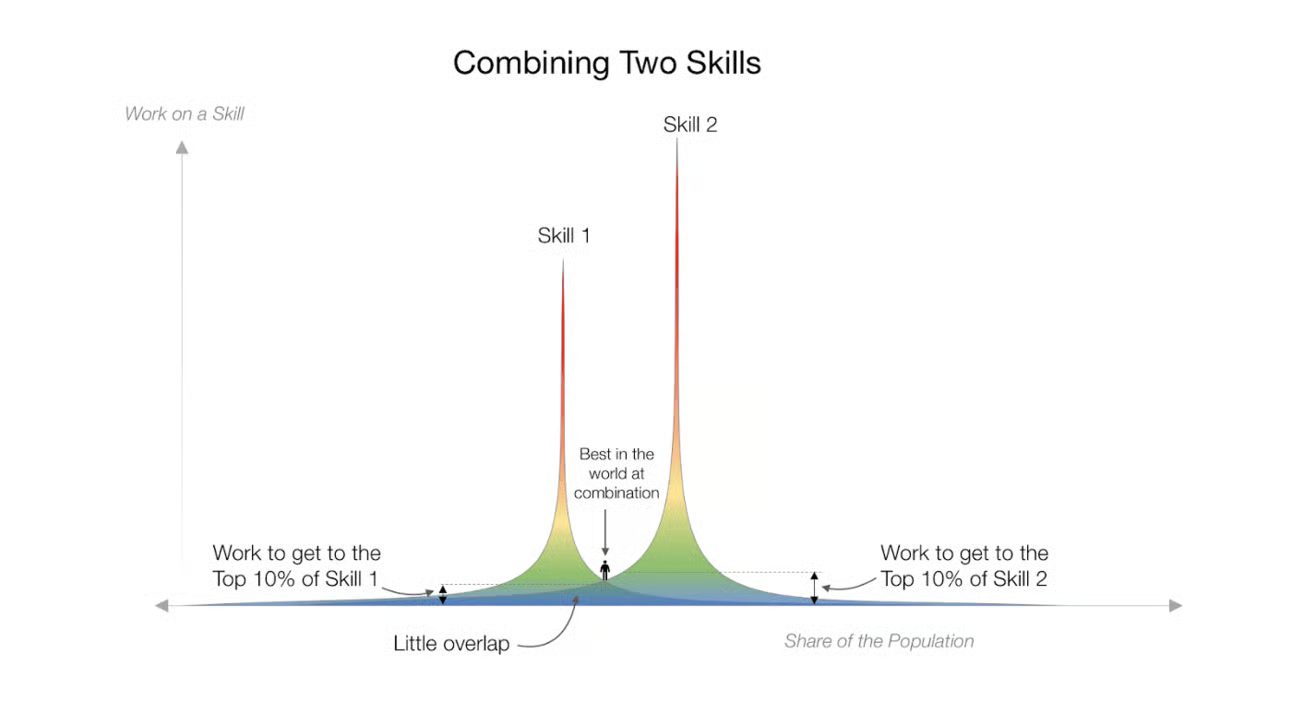
Your skillset will be rare.
And capitalism rewards things that are rare and valuable.
It doesn't take that much to be the best in the world in the combination of skills you bring.
"If you combine things you are not supposed to combine, people get interested." – Naval Ravikant
Try doing this exercise for yourself:
- List your 10 strongest skills.
- Identify where you're genuinely in the top 25%.
- Look for combinations that are difficult to replicate.
This exercise is how I ended up with a fairly unique job: building out international expansion from scratch for an EdTech scale-up.
I took three skills that I'm likely in the top 25% of:
- Entrepreneurship
- Leadership
- Speaking foreign languages
You'll find lots of entrepreneurs who are also good leaders. But it'll be difficult to find someone who can (a) get their hands dirty, (b) build a team, and ( c) do so over and over again in different countries because they can speak the local language (or learn it quickly – as soon as we decided to open the Turkish market, I started taking Turkish 1:1 lessons and studied vocabulary every day. Çok güzel.)
There was no competition for the job.
And you can do the same.
Bonus: according to Adams, one of those skills should be related to verbal or written communication (eg. public speaking, writing). If you're good at your job and a better communicator than most others, you'll soon become the boss of most others.
(This is also the reason why I index so highly on becoming a really good writer, and barely ever turn down public speaking gigs.)
Knowing your talent stack tells you what makes you rare. But rare alone isn't enough; we need to make it valuable. And prove that your stack is not random.
Part 2: The Through-Line Audit.
No matter how non-linear, squiggly, chaotic your career is, if you look closely enough, you will identify patterns.
Career coach Nii Ato Bentsi-Enchill developed a method that will help you find those patterns – the common thread unifying your career.
Three simple steps:
- Which problems did you solve? Employers don't hire because they want more people on their team, they hire because they want to solve a specific pain point. If you can show that you've solved this problem before in your career (no matter the industry), this gives you a leg up in the process.
- Which skills did you deploy? List which skills showed up regardless of context: systems thinking, public speaking, project management, sales. Those are your operating system. If you can sell CRM software, you can probably also sell … idk, me this pen.
- Which impact did you create? In those things that you did, list the impact you've had on others. Results, not activities. If you've had positive impact before, you'll have positive impact again.
List the 2-3 main problems you've solved in each role → circle the ones that repeat → note which skills you've used to solve them → quantify impact where possible → write one sentence capturing that pattern.
An architect who becomes a web designer and then an event planner shows a pattern of creating memorable experiences for people.
Might be compelling for a startup looking to hire a founding customer success manager.
But unless you spell it out for the hiring manager, they'll likely reject your CV because they wouldn't be able to see it themselves.
Now that you know your talent through-line, let's package it.
Part 3: Positioning.
Similar to the talent stack, identify your positioning with nuance. April Dunford (who wrote "Obviously Awesome" and somehow claimed the "positioning expert" title) uses this framework:
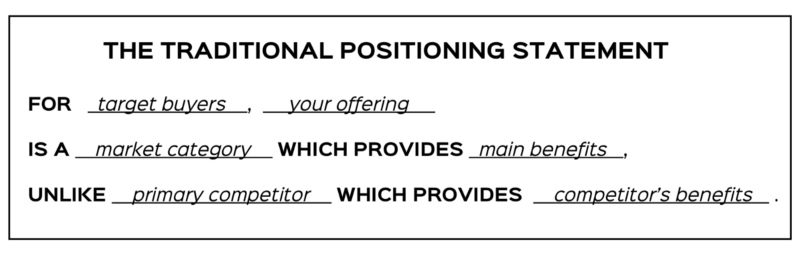
You can put this on a poster in a company office, but not on a CV.
Instead, you can use the following one-liners:
- "I help X do Y" → X is your desired employer, Y is their desired outcome (eg. "ship software products within days, not months") and not the activity ("write code")
- "I will [solve your problem] without [common objection]."
- Or, if you're still super early in your career: "Obsessed with X. Did Y." → this allows you to share a bit of context about you, while pointing out your uniqueness.
As a generalist, you'll likely be tempted to say: "but I can do anything, for anyone". While that's likely true, this isn't gonna get you hired.
Makes me think about this example from Hormozi's $100M Offers book (paraphrased):
- Weight-loss program: $19
- Weight-loss program – lose 20lbs in six weeks: $49
- Weight-loss program for stressed entrepreneurs – lose 20lbs in six weeks: $99
- Weight-loss program for stressed entrepreneurs in their 30s – lose 20lbs six weeks: $299
The more specific the solution becomes, the higher the willingness to pay is.
You can use the same in your application: employers don't want a random stack of skills, they want someone who can solve a specific problem.
Executive recuiter Doug Lester writes:
More specifically, our clients wanted a leader who had experience facing a particular challenge or set of challenges similar to their own, in a particular context similar to their context, and had proven success overcoming that challenge or challenges in that context, preferably several times.
It's up to you to tell that story in your application.
You've got the what (talent stack), the proof (through-line), and the packaging (positioning). But the best applications don't just inform.
They provoke.
Part 4: The Spiky Point of View.
I strongly dislike endurance sports. I just don't see how anyone would enjoy 20+km in a session. I also believe it's a fantastic way to get injured.
I'd much rather shoot balls at targets.
(Ask me again when I'm in my late-30s-midlife-crisis where most men start doing triathlon.)
That's … somewhat of a spiky point of view. It shows a clear edge, and I might piss some people off with it. (Like, men in their late 30s who just started doing triathlon.)
Wes Kao popularized this concept. She writes:
A spiky point of view is a perspective others can disagree with. It’s a belief you feel strongly about and are willing to advocate for. It’s your thesis about topics in your realm of expertise.
Most job applications I read are … very generic. Safe. To not piss anyone off.
Which is why to stand out, you have to show your edges. I personally value strong opinions highly: they invite a discussion, something to talk about.
(This is a common feedback I give to candidates: show a bit more of your personality. German hiring managers like that. You're more than just a list of jobs you've done!)
To identify your spiky POVs:
- Draft 10+ spiky POVs that you hold.
- Test it against Kao's criteria: Is it personal? Grounded in experience? Polarizing? Reframing an accepted idea? Practical?
- Would publishing it make you slightly nervous? If so, that's good.
Spiky POVs make for great content.
Somehow, one of my highest performing LinkedIn posts of all time is … about white chocolate and Google Meet. Personal, from experience, highly polarizing. Not sure if it's useful to anyone, though.
Include some spiky POVs – career-related ones – into your application. Anything that helps you stand out is good.
At this point, you've got a pretty sharp picture of yourself on paper. But there's one blind spot left: how other people see you.
Part 5: The Dinner Party Focus Group.
I love this one. Haven't tried it yet, but the idea is awesome. Credit goes to the book "Reinventing You" by Dorie Clark.
It's simple: invite 6-8 friends from different contexts to your house. Be a good host and make them dinner. Or cocktails, to elicit better responses.
Ask them:
- What are my greatest strengths?
- If you didn't know my job, what would you guess I do for a living?
Even better if you have someone else ask your friends; that might help them speak more freely.
The outcomes will help you tell your story.
Self-perception and perception of others often differ more than you'd think.
Conclusion
I set aside ~2h to write this post. It took me ~6h total, and was an absolute blast. Let's wrap it up:
- Identify the 3-4 "pretty good" skills and combine them into something rare and valuable.
- Audit for the common thread.
- Choose your category (or adapt it depending on which job you're applying to).
- Develop spiky points of view instead of saying what everybody else is saying.
- Rope in your friends to help you figure out your positioning.
Most generalists' story is "I've done a lot of different things."
Scratch that.
Now, it'll be "I'm the person that figures out the hardest problem in the room."
Let's get it.
If you enjoyed this post, follow me on social media:
LinkedIn | Threads | X | Bluesky | Instagram | TikTok | YouTube
Whenever you're ready, there are four ways I can help you:
[1] Reclaim up to 4 hours per day and find time to do the things you've always wanted to do by enrolling into Personal Productivity OS.
[2] Hire your next Founder's Associate or other business generalist position with my startup, Generalyst Recruiting.
[3] You could also find your next startup job in Europe by simply applying as a candidate.
[4] Learn how you can build your career as a generalist by subscribing to this newsletter. ⬇️

Dominik Nitsch Newsletter
Join the newsletter to receive the latest updates in your inbox.