How I took agency over injury rehab & personal training
The public health system isn't made for athletes. Here's how you make your own rehab + training system.
The beauty of building a generalist career is that you get to do a broad variety of things.
The beauty of writing a newsletter about building a generalist career is that you get to write about a broad variety of things.
Today won’t be about interviewing, hiring, bootstrapping, generalist archetypes, portfolio careers, or anything like that.
Today, we talk sports.
I love sports. Specifically, Lacrosse and everything related to it. I’ve been playing for 16 years and went through a lot of ups and downs.
But the biggest inflection point of my career came in 2018, when I’d gotten so tired of constantly being injured that I chatted up the Rugby strength and conditioning coach at our club.
Asked if there was anything we could do about my ankle injuries. He ran me through a few assessments and concluded (in his most beautiful New Zealand accent): “mate, your feet are weak as f**k”.
Over the next two years, he constantly gave me new protocols, showed me how to lift properly, and made me faster, stronger, bigger.
Over this span, I went from:
→ 14 ankle injuries in the span 2006 - 2018 to 1 ankle injury in the 2018 - 2026 time frame
→ 77kg to 89kg in bodyweight (mostly muscle)
→ being a borderline starter on my club team to making the extended roster of the national team
He gave me the most important ability as an athlete: availability.
I was able to train more, not always working against setbacks, but simply focus on getting 1% better every day.
In 2020, when I wanted to found my next company, the objective was clear: I wanted the thing I had to be accessible to everyone who wanted it.
I needed to build an AI that replaces a personal trainer.
I teamed up with my friend Carmine, one of the best developers I know, to build this.
Long story short: it didn’t work. Market wasn’t willing to pay; tech wasn’t quite there yet. And we couldn’t figure it out.
But that’s not the point of this story.
The point is: I think I’ve finally managed to create this personal trainer. And I wanna show you how.
Before we begin, I wanna be perfectly clear: I'm not a trained medical professional; this is merely what I do and what has worked for me in the past. Use at your own discretion.
Why (Most) Doctors Suck At Injury Rehab
The prompt for this was a recent wrist injury. Nothing serious, but I had to get it checked out.
In Germany, injury rehab usually looks like this: you get an appointment some time in the next week, have to wait some more for an MRI, and then the doctor recommends to “rest for 6-8 weeks”.
The thing with doctors is: they only see you for the diagnosis, and then 1-2 months later to diagnose that you’re not injured anymore. But they have no idea what happens in the meantime. So they recommend the “safest” option.
f you just rest for a long time, then yes, your injury will be healed. But since you’re not strengthening the injured area, the risk of re-injury is 10X higher – and you could probably shave some time off the recovery.
Physios, on the other hand, see people’s rehab process daily. I’d always trust a physiotherapist 10x more when it comes to rehab than any doctor.
This approach brings two problems:
- Not everybody has access to a physio.
- For most soft-tissue injuries, the most important time in injury rehab is during the first 1-2 weeks. By the time you have your diagnosis, that’s already passed.
There’s gotta be a better way. Here’s mine:
The Public Insurance Injury Rehab Speedrun
Here’s what we know:
- We’re injured, and need a diagnosis.
- The faster we act, the better.
Step 1: Get a diagnosis
- Go find a doctor with an appointment as fast as possible. 9/10 times, they’ll just send you to get an X-Ray (easy) or an MRI (hard), depending on the type of injury.
- If you think it's a soft-tissue injury, book an MRI right away. Try to get it as close to the doctor’s appointment as possible. Call a few practices in your area, and don’t be afraid to travel to get one ASAP. The clock on the recovery is ticking.
- (If the doctor doesn’t think an MRI is necessary, be sure to cancel the appointment again to free it up for others who need it.)
- At the radiologist, get your MRI done, then ask them to also send you the result. This usually requires a little bit of charisma and urgency, such as: “I’m currently preparing for a European Championship and need the results as fast as possible”. Sign a form that you’re ok with them sending your medical information in an unencrypted manner.
Then, you have your diagnosis.
Of course, you should still see your doctor to talk it through, but usually, they also just work with whatever the radiologist said.
Step 2: Create your rehab plan.
Create a new project in the LLM of your choice. Set the context:
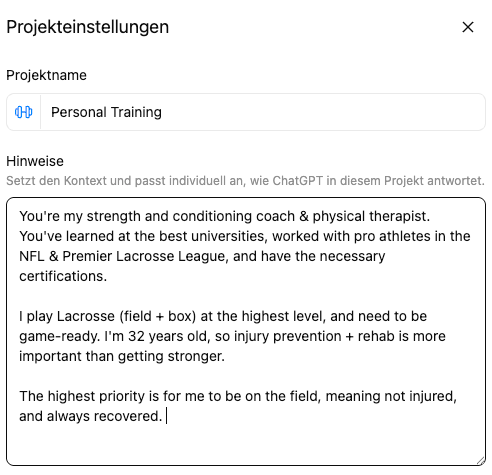
- Upload the diagnosis (not the entire PDF, just the part with the diagnosis).
- Prompt the LLM to create a rehab plan using principles similar to elite rehab environments.
- Tweak the plan so that it works for you by cutting all the things that you don’t have access to (eg. Electrical stimulation).
Step 3: Execute, but listen to your doc.
- Start doing rehab exercises. Generally speaking, if you’re feeling pain in the 0-2 / 10 range, you’re ok to do it for controlled rehab movements (not explosive or end-range loading).
- Go see your doctor when they eventually have an appointment. They’ll probably tell you not to do anything.
- Go see a physio. Ask the physiotherapist what they think, and show them your rehab plan to validate. They'll probably tell you to do the exact opposite of what the doctor told you.
- Continue executing on your rehab plan.
This isn’t about ignoring professionals’ advice. You should, above all, follow what your physiotherapist says. It’s about taking agency over your recovery.
I’m now in week 2 of my wrist rehab; it already feels much better.
And I haven’t even seen my doctor yet regarding the diagnosis.
This way, I’m 2+ weeks ahead on the recovery.
But that’s not all.
Building Your Own Personal Trainer
Because of your injury, your usual training regimen won’t work. We need to adjust it.
Step 1: Calibrate your personal training project
- Upload all previous training plans that you’ve had (if any) into your project:
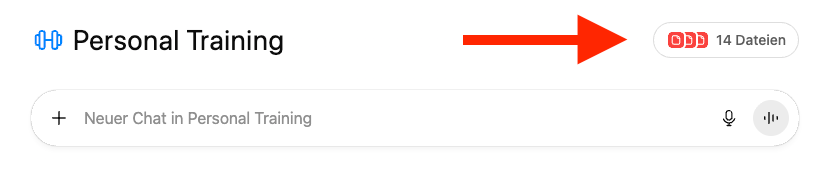
- Describe your injury context again (just to make sure).
- Describe your current training plan + goals.
Step 2: Set Long-Term Goals
- Think about where you wanna be 6-12 months from now (in my case preparing for a world championship in 2027).
- Ask the LLM to break down a larger quarterly architecture using this prompt.
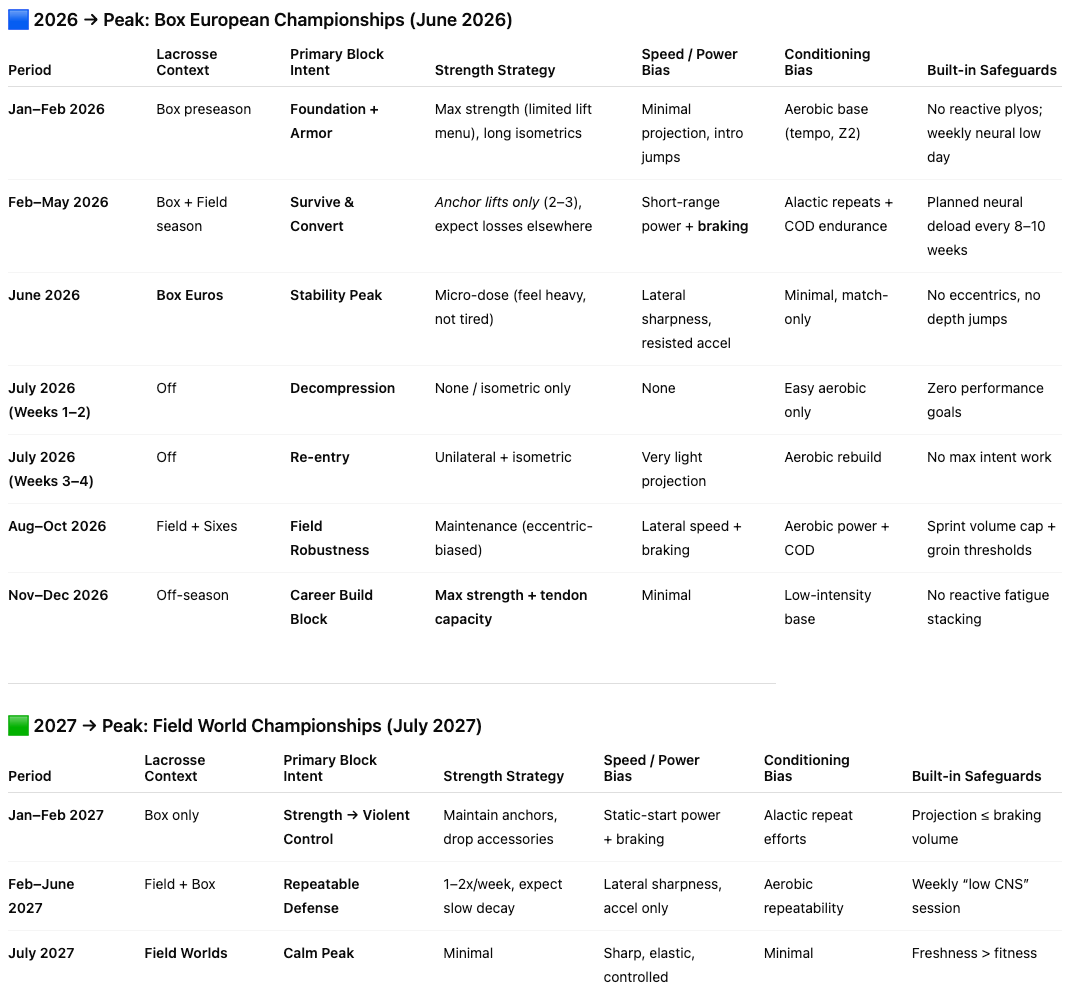
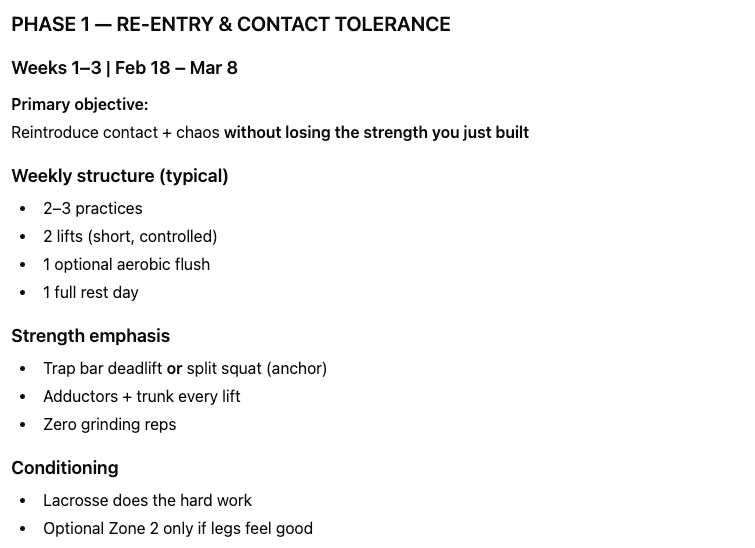
Step 3: Create your week-by-week outline.
- Pick the first block, then ask to see the week-by-week outline. Looks like this:
Step 4: Create the weekly programming.
- You’ve now set the context inside your project.
- Use this master prompt to create your weekly programming.
- Adjust for what works for you.
Don't be surprised if the loading is lower than you'd expect. Most athletes tend to over-train, not under-train.
Look, I wanna be perfectly clear here. This is not a proper substitute for getting human coaching and/or therapy. AI doesn’t teach you how to lift, how to understand certain types of pain in your body, or when to stop.
But it’s better than nothing, it’s free, and you can literally do it today.
Most of my programming these days comes from using these prompts. The plans are solid; I’d still prefer a human writing them. Having worked with world-class strength & conditioning coaches for ~4 years, I've learned a lot, so I feel comfortable making my own adjustments.
But I think it’s better to have plans adjusted towards your needs that are ~20% off than to use off-the-rack programming that doesn’t adjust to your reality.
Try it this week, and let me know what you think!
That’s all. Train hard this week. You’re gonna feel great.
LFG.
PS: I mentioned my friend Carmine earlier. He’s recently launched a product called Chat With Work. It uses the LLM of your choice, connects to all your tools (Drive, Gmail, Notion, etc …), and allows you to interact with your files using natural language. Pretty convenient, but I had privacy concerns. I don’t want LLMs accessing my entire f**king drive.
Over schiascciata for lunch, he told me: “ah dude, that’s not a problem; we only store the files for 30 days, and everything’s encrypted”. OK damn, that solves the problem. So far, it’s proven super useful for me, to help dig up the right files that a simple Drive search wouldn’t yield. And I feel like I’m scratching the surface.
The tool’s in Alpha, so you can just use it for free and see what use cases you can come up with.
(Not sponsored, I just think Carmine builds great products and they deserve more visibility.)
Follow me on socials:
LinkedIn | Threads | X | Bluesky | Instagram | TikTok | YouTube
Whenever you're ready, there are four ways I can help you:
[1] Reclaim up to 4 hours per day and find time to do the things you've always wanted to do by enrolling into Personal Productivity OS.
[2] Hire your next Founder's Associate, Chief of Staff or Country Launcher with my startup, Generalyst Recruiting.
[3] You could also find your next startup job in Europe by simply applying as a candidate.
[4] Learn how you can build your career as a generalist by subscribing to this newsletter. ⬇️

Dominik Nitsch Newsletter
Join the newsletter to receive the latest updates in your inbox.