How to develop skills & achieve your goals in 2026
One of the biggest downsides of being a generalist: not being able to measure your improvement. The answer: a six-step framework & the Harada Method.
It’s been a wild year. Yet at the same time, it felt like working on more or less the same things most of the time.
Which left me wondering: what did I actually learn this year?
What skills am I developing?
Like, I’m selling, but I don’t feel I’m getting a lot better at it – most of the selling in my line of business is done with a fairly easy pitch, where you only pay if something actually works. This isn't super hard.
Writing? Maybe. I write a lot. But I also feel like I’m not taking structured lessons in it. I just … write.
And the only quality indicator I get to look at is the subjective feedback (“I love your writing”, but you never hear the opposite), as well as unsubscribes and open rates (increasing and decreasing, respectively, which is a good thing).
Interviewing? Possibly. But again, hard to measure skill development here. I feel like I can get a read on a candidate in 5-10 minutes, but have very little data to confirm that my judgment was actually correct. Which kind of kills the feedback loop.
And yet somehow, I feel like I’m developing a valuable skillset. It’s hard to put a finger on it. But the things I do today, I wasn’t able to do one year ago.
This, dear reader, is one of the biggest downsides of being a generalist. We specialize in soft skills, not hard skills. And soft skills are hard to measure.
Take a physical skill like, idk, lock picking.
It’s binary: you can either pick a certain a lock or you can’t.
A soft skill like talking to people, on the other hand, exists on a spectrum. There are better and worse conversationalists, but as long as you’re not mute, you can talk to people. Nor is there an upper limit to the skill; you can always get better.
Which leaves the question: how do you measure improvement?
Six Steps for Improvement
For now, that feels impossible.
Because you can’t measure what’s not yet defined.
So first, we’ll need to define what we want to get better at. For this, we need:
- Metrics: the axis along which we’d want to improve
- Baselines: where we currently stand based on the metric
- Goals: where we want to go
Then, repeat for each other skillset you’d want to get better at. Does that sound familiar?
Because indeed, there’s a parallel world where character development like this is really important: video games.
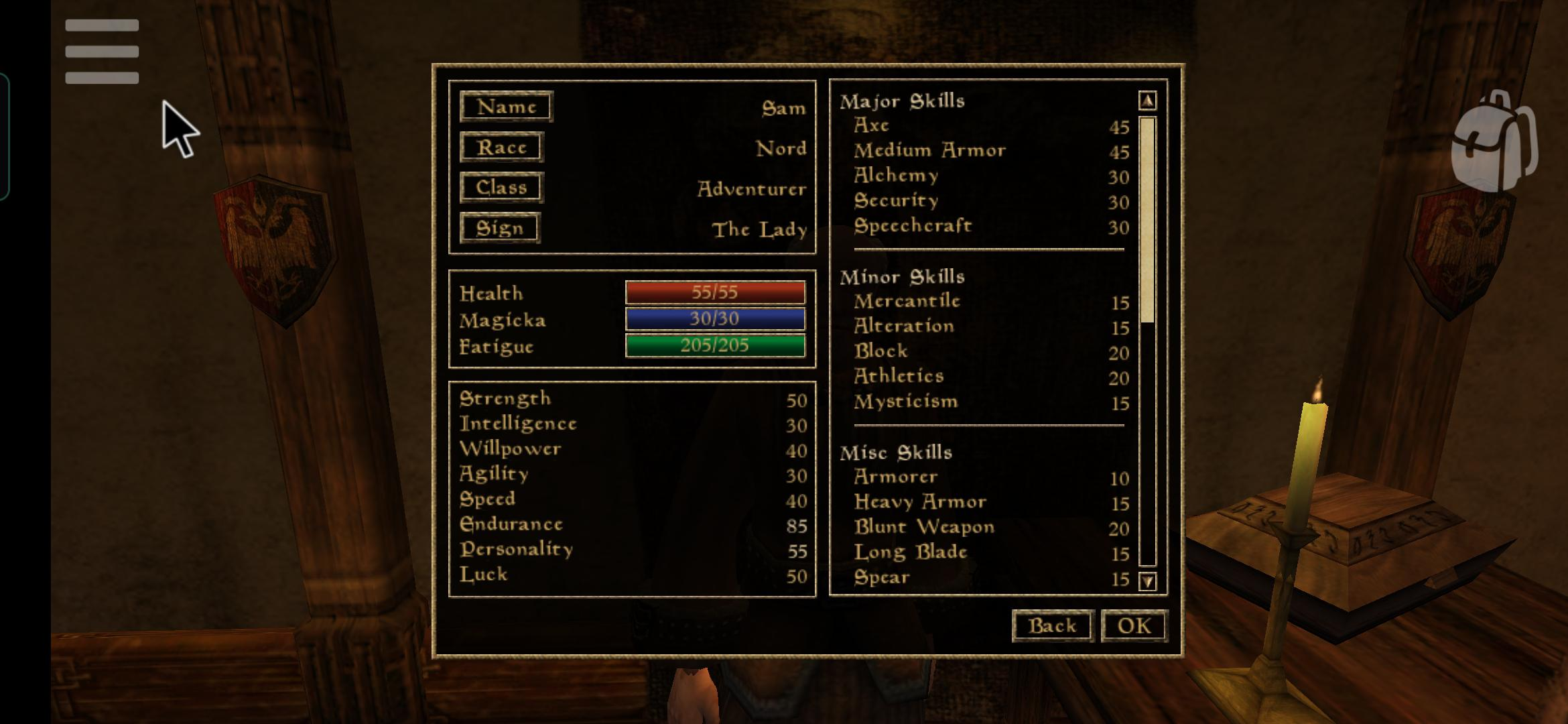
In a way, your skillset as a generalist is like the skill trees of video game characters.
You can either max out one skill tree, or allocate points along several ones. (Interestingly enough, thinking back to my childhood, I’d always build balanced characters instead of doubling down on one specialty.)
So really, the way to grow is just … allocating skill points in a video game? Cool.
How do you get these skill points?
- Time: the more time you spend on something, the better you will get at it
- Knowledge: the more you know about something, the better you will get at it
Interesting. We’re getting somewhere here.
Now, the process looks like this:
- Identify the skill(s) that you want to develop
- Establish how you’d measure progress in said skill development
- Based on this measure, identify your baseline
- From that baseline, identify your objective for the next time period (in our case, let’s say year)
- Allocate time accordingly
- Identify the right sources of knowledge to get you there faster: mentors, coaches, books, courses, classes, you name it.
That’s a framework we can work with. Let’s make it specific.
For example, in 2026, I want to:
- Go from solopreneur to entrepreneur: hiring a bunch of people so that the business runs even if I take 2 weeks of vacation → this implies that the business is making enough money
- Go from 1k subscribers to [redacted], but a significantly higher number – CC: Prof. Gollwitzer
- Speak Portuguese at a B1 level so that next year in Brazil, I can have actual conversations with people
- Become a better Lacrosse defender in preparation for an upcoming international tournament
Now, each of these goals can be broken down into skill gaps. Would be valuable to do this exercise for each of these aspects, but for simplicity’s sake, let’s take the Lacrosse defensive example.
(For the following section to make sense, spend 30 seconds watching this video to get an idea of the physicality of Lacrosse.)
What you see there, is part of my job on the field. Disagreeableness is important.
Let’s improve it.
(Quick note: if you’re not interested in Lacrosse or contact sports at all, skip this section and continue at “The Harada Method”.)
1 – Skill Development
First, we need to establish the skills necessary to become a better Lacrosse defender.
- Physical Skills:
- Stickskills
- Strength benchmarks
- Conditioning benchmarks
- Speed & agility benchmarks
- In-game skills (eg., one-on-one defense - fundamentally a combination of the other 4 factors)
- Mental Skills
- Ability to read the game
- Decision making
- Mental strength
- Communication & leadership
I know that my game isn’t being the most physical player. I win by seeing plays before they happen, by making sure that everybody is where they’re supposed to be. Which makes me an off-ball defender - the guy that makes decision and quarterbacks the defense, not the guy that takes out the best opposing player.
(If you’re thinking in terms of American Football, not a cornerback but a linebacker.)
In my case, mental strength is the biggest issue: I’m not disagreeable enough; as a defender you cannot be afraid of hurting other people, physically and mentally.
Let's work with that for now.
2 – Measurement
Problem: how the f**k do you measure disagreeableness? Not a clear issue, but a score that you have to invent for yourself.
ChatGPT came up with this scoring method:
- Early contact vs. late contact – disagreeable players initiate contact; agreeable players wait for the opponent to come. +1 for each initiated contact.
- Communication under stress – disagreeable players make decisive, directive calls; when running a defense, that’s important. +1 for each directive call
- Penalty profile – if you don’t get any penalties, you’re too agreeable; but you can’t get penalties that result from mental breakdowns (ie. trailing checks, unsportsmanlike conduct). Sweet spot: 1-2 acceptable penalties per game (such as defending a bit too hard, hitting a bit too late, or taking a tactical penalty).
3 & 4 – Establishing Baseline & Goal
Nice. Now, I can look at game film from this year and establish a baseline. Based on this baseline, we can now establish a goal. For instance, by the end of the year, I’d want to:
- Initiate contact on at least 50% of on-ball defense occasions.
- Make 20 directive calls per game.
- Take at least one, but never more than 2 penalties per game.
Knowing this, I can now go into practices and games and keep tally – do I constantly get better?
5 & 6 – Allocating Time & Resources
Since I’m already practicing and playing anyway, I don’t need to allocate additional time to it.
Resources are a different story. For example, I could:
- Work with a sports psychologist to help me work through those aspects
- Read autobiographies of defensive players (also from adjacent sports like American Football or Ice Hockey)
- Train with an even more physical sport (eg. asking the Rugby guys to teach me how to be an absolute menace)
Now, this is just one aspect of many of being a good defender. You can use the above process for any other aspect here, too.
And there’s a cool framework for it:
The Harada Method
Shohei Ohtani is one of the most iconic Baseball players out there. He’s, as far as I know, the only pitcher that’s also a batter. (A baseball generalist, if you will.)
To get there, he used a method invented by Japanese track coach Takashi Harada, where you break down an ambitious goal into its component parts.
Looked like this:
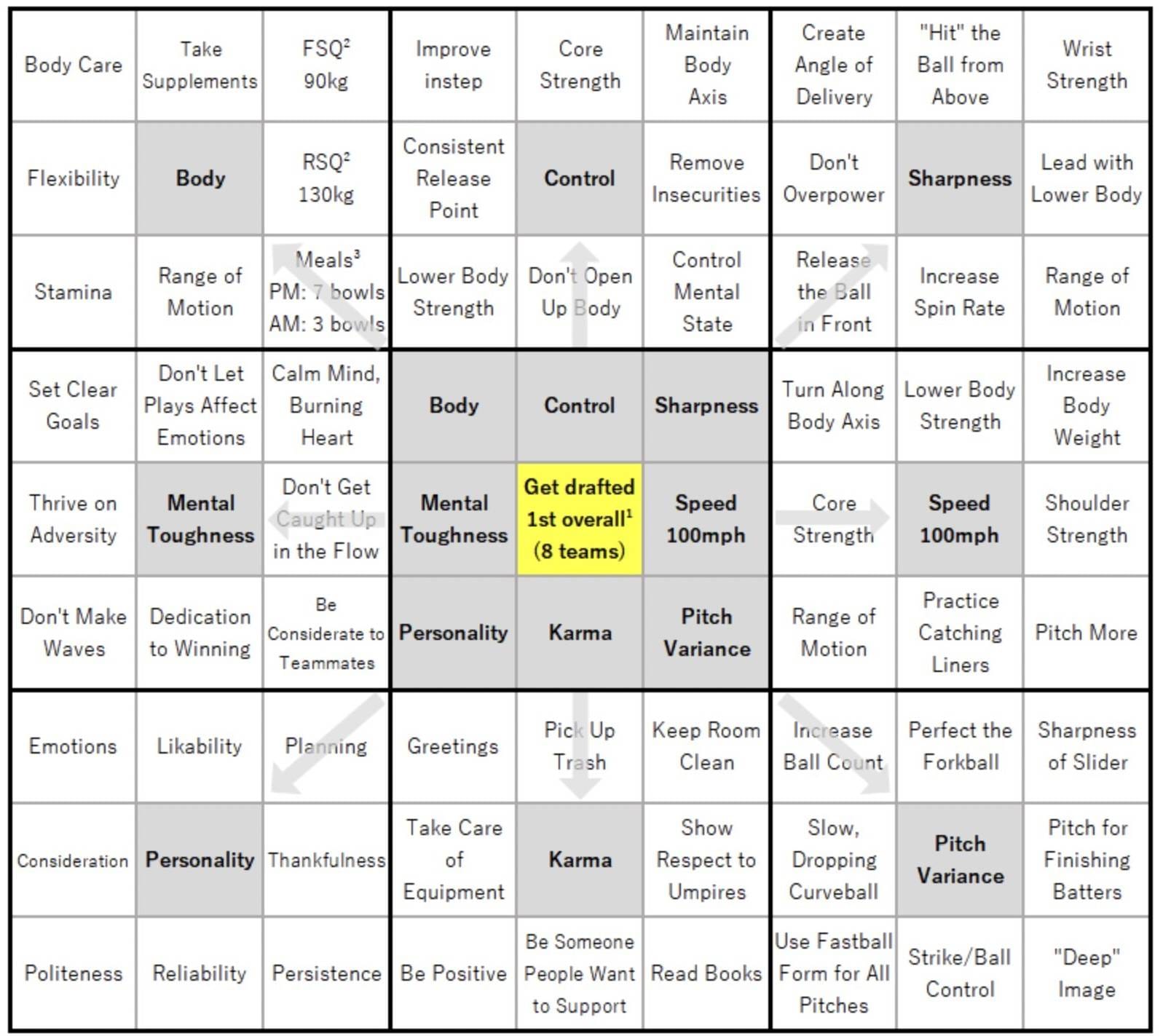
You can use this for any skill you want to develop, any goal you want to achieve.
And if you have more than one goal, you can do this for each of them, and then layer over the skill development framework on top of it.
Yeah, that’s a lot of work.
But in order to get extraordinary results, you need to do extraordinary things.
Call to Action
This is your homework for the time between Christmas and NYE.
- Identify what you want to achieve next year
- Build your Harada matrix
- Layer the skill development framework on top of that
- Derive concrete KPIs and action items
Is this too complex?
Maybe. I’ll test it and find out. Hope you will too. :)
Either way: life is about growth – and growth fundamentally means improvement at something.
So as long as we improve, we grow, and we live.
If you stop growing, you stop living.
Have a great week. LFG. 🔥
LinkedIn | Threads | X | Bluesky | Instagram | TikTok | YouTube
Whenever you're ready, there are four ways I can help you:
[1] Reclaim up to 4 hours per day and find time to do the things you've always wanted to do by enrolling into Personal Productivity OS.
[2] Hire your next Founder's Associate or other business generalist position with my startup, Generalyst Recruiting.
[3] You could also find your next startup job in Europe by simply applying as a candidate.
[4] Learn how you can build your career as a generalist by subscribing to this newsletter. ⬇️

Dominik Nitsch Newsletter
Join the newsletter to receive the latest updates in your inbox.