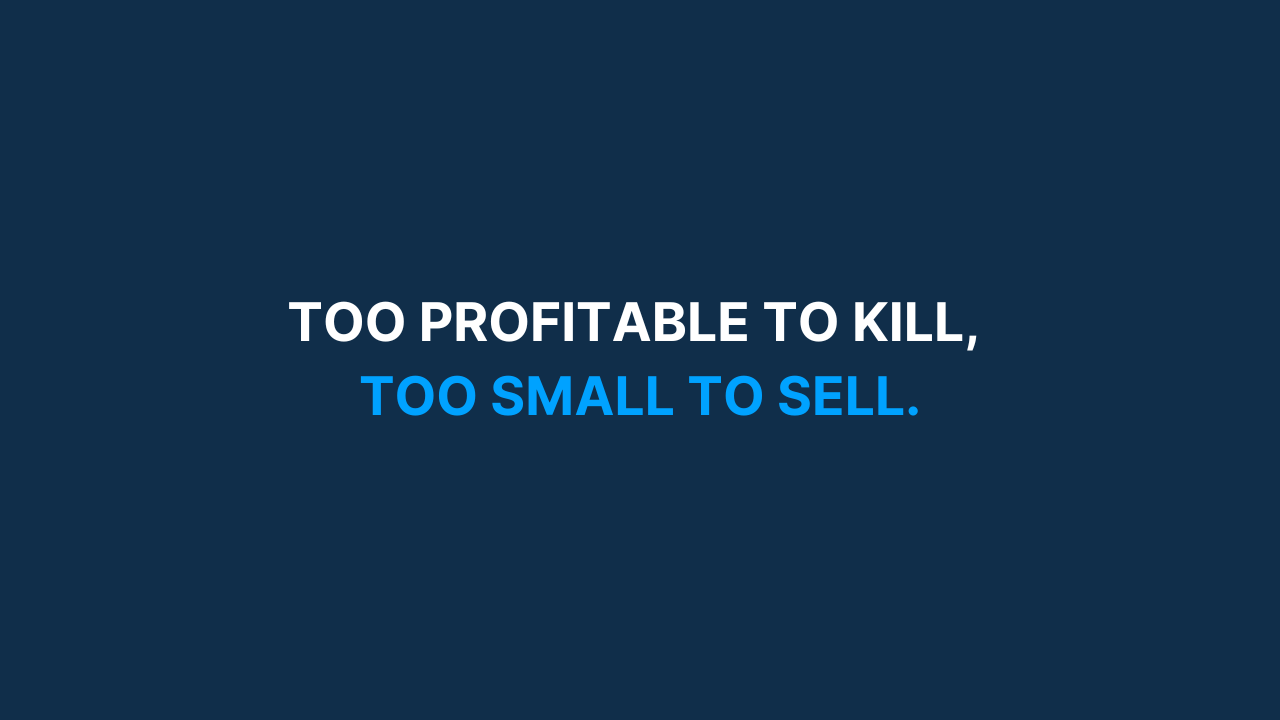
Too profitable to kill, too small to sell
How startups end up in purgatory – and how I'm keeping mine out.
When we think about startups, we think about them in binary terms: either a startup is a success, or it’s a failure.
We hear about successes all the time: multi-million exits, rags to riches, all those stories. There is, of course, a huge survivor bias here. The absolute vast majority of startups never make it this far.
We also, sometimes, hear about the “failures” (quotation marks intentional, as I believe failing is part of the journey and totally okay): startups that don’t make it through. According to this study, 89% of startups founded in 2013 are dead, with only 6% having exited.
But we never talk about the space in between – what I call startup purgatory: the area where the business is too profitable to shut down, but not profitable enough to sell or … be fun.
I’ve been in startup purgatory before: my first startup, Linguedo, has been around for 10 years now. Growth stalled after year 4 or so, and while it’s been profitable, it’s never really gotten to become the company we once envisioned it to be. At the time, we didn’t realize that that’s where we’re going - but we did end up there.
Not a great place to be. You’re kinda stuck with your business, it’s not really fun, nobody wants to take it off you, but shutting it down also seems rather stupid.
- How did we end up there?
- How do you escape it?
- How do you detect you are in startup purgatory?
- And, most importantly: how do you avoid getting to startup purgatory in the first place?
There are the questions I wanna answer in this article, using a three-part framework. (And then show you how I’m doing it at Generalyst.) Let’s go.
1 | Prevention
“All I want to know is where I'm going to die so I'll never go there” – Charlie Munger (RIP)
The best way to avoid startup purgatory is to never go there. These are the design choices I’m making at Generalyst to do that:
Bootstrapping
A lot of companies I know are in purgatory that is created by investors. The business is too small to be a proper exit; too profitable to be shut down; and the founder can’t sell their shares (because, for instance, the preference stack would leave them with zero return on it.) The pressure to be a fund returner makes the threshold for a business to be “fun” very high.
Bootstrapping changes that. A business doing 300-500k in EBIT per year is dogs**t for a VC-backed company, but super fun for a solo founder owning 100% of the company. So while bootstrapping doesn’t exactly avoid purgatory, it redefines where it starts. I believe it’s much easier to get to the “fun” zone with a bootstrapped business.
That being said, bootstrapping also makes it harder to think really big (and therefore might even cause purgatory). But worry not: there’s a solution to that …
10x vs. 2x Thinking
One of the biggest reasons why we ended up in purgatory at Linguedo was incremental improvements. We weren’t taking big swings; we were mostly trying to execute projects and get slightly better every day, focusing on small wins now instead of big wins later.
Example: most of our customer acquisition happened via paid ads. It worked, but it was expensive. One year after founding the company, we first discussed adding proper content marketing: a blog, a social presence, lots of lead magnets – things that pay off in the long-term, not right now.
But we never really managed to allocate the resources to this, so we kept shoving money down Google’s and Meta’s throats. While we got pretty good at performance marketing, we never got the big returns of free candidate flow.
Throughout most of my life, I’ve fared well with incremental improvements. In sports, this is exactly how you get better: daily reps, 1% better every day. You can’t just double your squat and expect it to work – that’s how you get injured. But progressively overloading your lifts works.
In business, that sort of works. But why go for 2x if you could go for 10x?
A mental experiment I do regularly is to ask myself:
- What would I do to 2x the business?
- What would I do to 10x the business?
The answers to the first question are usually incremental: better processes, just doing more, trying small experiments.
The second question reframes things entirely: it makes you question the business and operating model, and opens up creative space for the big swings.
Incremental improvements just increase your hourly rate as a founder. 10x improvements disconnect your hours from the returns. And that’s where we wanna be, also because …
Build to sell your business (even if you’re not planning to)
I spoke to a longtime subscriber yesterday. He had just been involved in one of the bigger acquisitions in 2026 in Germany. This quote stuck with me:
“if I ever found my own company, I’ll pay people to do a proper due diligence (DD) regularly, even if I’m not planning to sell.”
DD professionals are experts in poking holes in your business. Once you know where the holes are, you can fix them. It also forces you to be diligent with your finances, to view your business as it is, and to spot problems in the overall model.
Thinking about selling your business forces you as a founder to take yourself out of the equation. Right now, for instance, Generalyst is very much dependent on me. If someone were to buy it, they’d mostly buy “me”. But that’s not exactly the freedom I’m looking for as a bootstrapped entrepreneur.
I wanna take holidays. I want to be able to work deeply on a project for a few days without having to worry about day-to-day operations. And I can only do that if I build systems, establish a strong brand, and - most importantly - have the right people in the right seats.
And if someone were ever to express interest in buying, you’re ready. Time kills all deals. The fewer days it takes to get a deal across the finish line, the better.
As author Sebastian Mallaby said when asked what he’d put on a billboard: “prepare your mind.” This is the business equivalent of it.
Ideally, this is where we stop. But sometimes, you might already be drifting … without knowing it.
2 | Detection
“If I knew back then what I knew today, I would’ve never started this business” is something I said quite a lot during my time at Linguedo.
It never occurred to me back then, but I think that was one indicator of purgatory. Sure, it was hard to get there; building a business is always harder than you expect, even when you expect it to be hard.
I call this the “zero-based test”: would you start this business today, knowing what you know?
If yes, fantastic.
If you say no two years in a row, you might be well on your way to purgatory. Working in a business that you wouldn’t start in the first place anymore doesn’t sound like a great idea.
It’s also worth calculating your opportunity costs. I’d be much better off financially had I followed the well-trodden path of just becoming a consultant after university. I’d be on my track to partner now, or left after a few years there and now work in a large company with a cozy salary.
Instead, I’m bootstrapping yet another business where I pay myself enough to comfortably live, but not more – all profits are reinvested. This is fine, because there is a clear financial upside: salaries in the open market are capped; upside in your own company is uncapped, and nobody ever became filthy rich by being employed.
This calculation leaves out the freedom you get from being self-employed, but it’s still worth looking at. You can’t be just scraping by financially forever.
Once you’ve detected you’re in purgatory because you wouldn’t do it again, and have way-to-high opportunity costs, how do you get out?
3 | Escape
“Purgatory is only a prison if you’re inside.”– the biggest philosopher of these days, Claude Fable 5
Convert to a lifestyle business
One smart move my co-founder at Linguedo did after I left: he promoted our best employee to COO, and eventually handed over the entire business to her. This allowed him - while being in purgatory - to at least live a very good life, with little workload and a steady salary.
Cut every unnecessary expense, stop trying to grow at all costs, and just milk the cash cow as long you can – while freeing up time and energy to work on the next thing, or in proper portfolio career style, pick up another gig.
Automate. Eliminate. Delegate.
Separate identity from business
Doing something else also helps with hedging your identity. If your business is you, then you’ll have a hard time getting rid of it. But if your business is just a part of a diversified identity (just like you’d diversify a stock market portfolio), getting rid of it becomes much easier.
Pick up a new hobby. Work on a new side gig. Become part of a group (no cults, please).
I try hard to not be the “Generalyst” guy. Yes, I’m an entrepreneur, and right now the entrepreneurial vehicle is Generalyst. But I’m also a writer & podcaster (👀), Lacrosse player, angel investor, Magic: the Gathering enthusiast, partner, friend.
So if for some reason, Generalyst should cease to exist (it won’t), then I still have plenty of other identities to lean on.
(Bonus: once you’re an entrepreneur, you’re always an entrepreneur, the next business is already out there.)
Nobody wants to be in purgatory. Prevent it; if you can’t, at least make sure you know that you’re in it. And if you get there anyway, there are ways to escape it.
Hope you enjoyed this read.
LFG. 🔥
Follow me on socials:
LinkedIn | Threads | X | Bluesky | Instagram | TikTok | YouTube
Whenever you're ready, there are four ways I can help you:
[1] Reclaim up to 4 hours per day and find time to do the things you've always wanted to do by enrolling into Personal Productivity OS.
[2] Hire your next Founder's Associate or other business generalist position with my startup, Generalyst Recruiting.
[3] You could also find your next startup job in Europe by simply applying as a candidate.
[4] Learn how you can build your career as a generalist by subscribing to this newsletter. ⬇️

Dominik Nitsch Newsletter
Join the newsletter to receive the latest updates in your inbox.