🎆 The Not-To-Do List for 2026
Planning your year is like great writing: "if I had more time, I would've written a shorter letter." Addition by subtraction.
Our day has 24 hours. It’s jam-packed. We’re scheduled, busy to the brim.
And yet, every year on January 1st, we believe that we can simply add more stuff to our calendar. The very same calendar we’ve struggled to keep under control for the last year.
In a way, managing our time is like writing. For that to make sense, let’s look at this quote from Winston Churchill:
“if I had had more time, I would’ve written a shorter letter.”
Good writing comes from subtraction, not addition: the ability to convey a message with the least possible amount of words.
Our lives are similar: we can’t just add more stuff and think we’ll get better results. Often, removing things is what truly moves the needle.
That’s why, every year, I write a Not-To-Do List – a list of things to stop doing, to remove from my life.
This is the 2026 edition of things I wanna avoid:
1 – Ignore the Not-To-Do List
I was just reviewing the list for 2025.
 Dominik Nitsch
And realized that for most of the year, I did exactly the things that were on the list:
- I still stuck to commitments even though they didn’t make sense anymore,
- I still mostly worked from home,
- showed up an average 2.5 min late to a meeting,
- didn’t really learn anything new,
- and was distracted as f**k.
A classic case of “we don’t rise to the occasion, we fall to the level of our systems”.
I simply wrote the words, but never implemented the corresponding systems. What I really should’ve done is:
- Use my weekly planning block to assess all appointments and gracefully cancel the ones that no longer make sense
- Set a clear day of the week to work from a different place (to be fair, I started doing this in December, and it’s working)
- Shorten all meetings to 25 minute slots (did this) and actually adhere to them (did not do this)
- Set clear learning goals and devise the right habits and environments to adhere to them
- Test different rituals and systems to minimize distractions
Good. Will add this to my to-do list.
Oh, wait … doesn’t that run counter to the logic outlined above?
Yes and no. Yes in the sense that we truly should remove things; but if we do one thing that helps us remove other things, then that makes sense. Kind of like adding “declutter my closet” to your to-do list.
One crazy good addition that removed 100 distractions was Opal. (Not an ad, the app genuinely made a difference.)
Fundamentally, Opal makes it really hard to access distracting apps on your desktop + phone. I’ve blocked out all social media as well as a few other sites from 08:00 - 18.00 during the week. The biggest benefit: it keeps my breaks short; sometimes, I’d otherwise go down a 20 minute social media rabbit hole. Not with Opal.
I really, really like this app. Try it for yourself (free for 30 days with my affiliate link - so I guess it’s kind of an ad?).
2 – Check Email more than 3x / day + touch any email more than once
I run a business that’s highly communication dependent. Email is an important tool for me. (Alas, you’re reading this … in your inbox. In fact, I’ve sent 58.698 emails in the past 365 days.)
But just because it’s an important tool doesn’t mean I should be using it all the time. You don’t chop down a tree by picking up your axe every five minutes, chopping out a small chunk, then putting it down again. You pick up an axe, set aside some time, and chop down the entire tree. You batch the activity. Then, you take a break and move onto the next tree.
Your emails, fundamentally, are a bunch of trees to be chopped down. But we use them to make a few chops here and there, never to make any meaningful progress.
Now, I have three time blocks to handle all communications: 11am, 2pm, 5pm. This should be sufficient for all communications. Nobody’s gonna die if I don’t get back to an email within 16h max.
In a given block, each email gets the same treatment:
- Delete → lots of emails simply don’t matter, get rid of them ASAP
- Delegate → someone else can handle matters, too (I usually delegate to my Founder’s Associate, you should get one too)
- Do → if it takes less than 2mins, just do it now
- Defer → create a specific task in my task management system to do it later
The key here: touch every email only once. (No news here, this is the “Inbox Zero” method popularized in 2006. Time-tested wisdom.)
I tend to touch emails far more than once. Not good. Drains mental capacity, clutters the inbox, because I “don’t wanna deal with it right now”.
That’s gonna change in 2026.
NB: You can apply the same logic to all other incoming messages. I see a lot of people out there struggling with 37 unread WhatsApp chats. Batch, pick one of the 4 D’s for each of them, bask in your newfound productivity.
3 – Make promises I’m not confident about
Sometimes, I interview a candidate where I feel like “something’s there”. Then, I accept them into the Generalyst program – even though, deep down, I already know they’re not gonna find a job via the program. Same goes for startups who are hiring: for some of them, I already know that I won’t be able to find a candidate. But I say yes anyway.
“Giving it a shot” might be the kind thing to do. I’d argue that early on in a startup, it’s even the right thing to do – you’re still in exploration mode.
But as soon as you figure out what works, it’s a bad use of time and energy. Double down on what works first, before exploring adjacent opportunities again.
Everybody’s better off with early honesty. That way, you don’t build expectations that cannot be met.
This works in most areas of life. Trust your gut feeling on everything where you already have a large frame of reference.
Honestly, that’s already enough. I’d much rather implement a few things tightly than many things not at all (see: 2025).
Implementation
As identified, the biggest issue in the past has been the implementation of systems. The work is clear:
- Go through the action items from (1) and implement those properly.
- Set blocks to process email + LinkedIn, stay away from them otherwise (and maybe have Opal block them even!)
- Write a notecard reminder that’s under my screen that says: “is this what you truly believe, deep down?”
And then, get after it. None of these systems are perfect, but directionally, they’re correct.
As you can see with my past posts (2020, 2021, 2023, 2024, 2025), it’s an iterative process. I’ve come a long way since 2020.
What’s gonna be on your not-to-do list for 2026?
A special thank you
The last “Not-To-Do List” went out to 519 subscribers. This one goes out to 1085.
Thank you, dear reader, for taking time out of your day to read this newsletter every week. I hope it’s helpful.
Writing has become a recurring source of joy for me. It wouldn’t be as fun without you. Thanks for giving me that opportunity.
Have a wonderful beginning to 2026.
LFG. 🔥
PS: A cool piece of trivia: “Inbox Zero” doesn’t refer to having your inbox at zero all the time (which would be a full-time job); it refers to email taking up zero space in your brain. I love that.
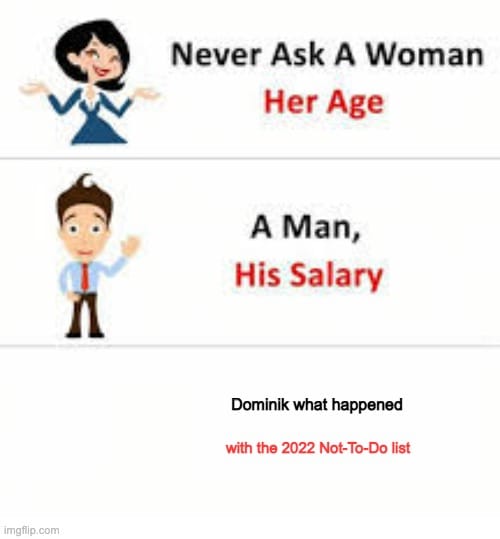
PPS: Here are the previous editions:
Expect more activity from me in 2026 on social media that's not LinkedIn. Be one of the first to follow, and pick your fav channel below:
LinkedIn | Threads | X | Bluesky | Instagram | TikTok | YouTube
Whenever you're ready, there are four ways I can help you:
[1] Reclaim up to 4 hours per day and find time to do the things you've always wanted to do by enrolling into Personal Productivity OS.
[2] Hire your next Founder's Associate or other business generalist position with my startup, Generalyst Recruiting.
[3] You could also find your next startup job in Europe by simply applying as a candidate.
[4] Learn how you can build your career as a generalist by subscribing to this newsletter. ⬇️

Dominik Nitsch Newsletter
Join the newsletter to receive the latest updates in your inbox.