Your beliefs have an expiry date
Most beliefs you hold were useful at some point. But maybe not anymore.

"When my meetings are over, I can finally start working."
I'm sure you've said a version of this. I certainly have. Sitting in meetings all day, feeling unproductive, feeling like nothing's getting done.
Hold on one sec, I thought. I'm a manager. It's literally my job to be in meetings.
A manager's job isn't doing the work yourself; it's making sure the work gets done. And meetings play a huge part in that.
So I redesigned my day and my productivity system to put meetings (and meeting prep!) front and center. Everything else went around it.
Meetings weren't unproductive anymore (as they often are when you're the one doing the hands-on work!). They were my main job.
That belief – "meetings aren't real work" – wasn't stupid.
But it had expired. It used to serve me well, but not anymore.
Most limiting beliefs work like that. They were right once. So where do they come from?
The Money / Time / Energy triangle
Life comes in phases:
- when we're young, we have lots of time and energy, but no money
- when we start working, we have energy and money, but no time
- when we retire, we have money and time, but no energy
(Having all three at once is one of my most aspirational goals. Hard, but not impossible – and a topic for another newsletter.)
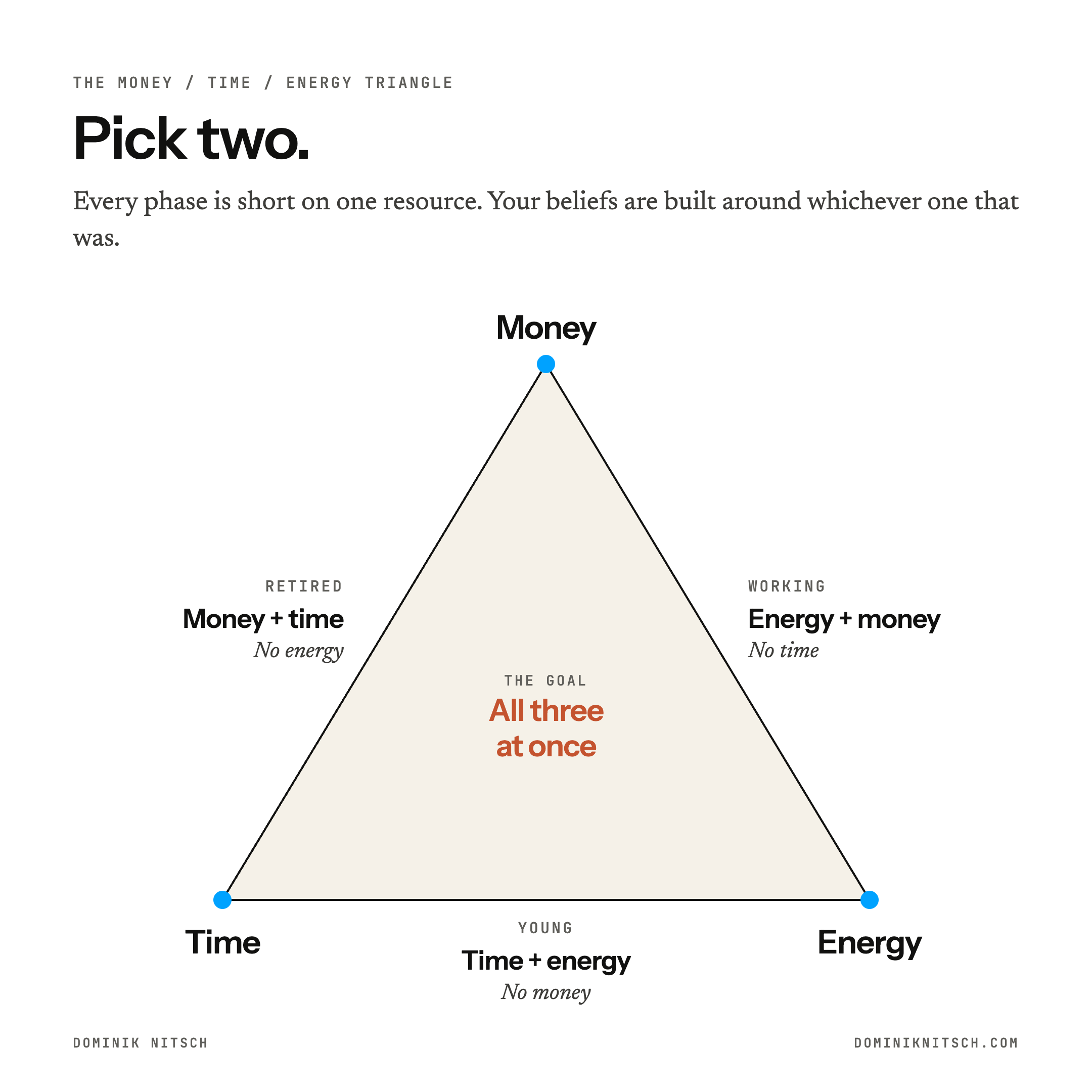
We grow up with limited money. So it's only natural that a lot of our beliefs revolve around saving it.
Then we start working, and money stops being the bottleneck. Now, it's time. But we keep acting like broke students:
- walking, or taking 45 minutes of public transport, when a 20-minute Uber costs 8€
- cleaning our apartment ourselves instead of hiring a 20€/h cleaner
- going to the supermarket further away to save a few euros on a sale
My personal favorite: flight hacking. As a student, I was an absolute master of finding cheap flights. It let me travel to cool places a lot. A genuinely valuable skill.
I still do it. I'll dig through every option and get so immersed that I spend hours on it. Sometimes a full afternoon comparing routings and prices. Just to save … 120€ and end up on a slightly worse routing.
120€ for four hours is 30€ an hour. Great value when you're a student. As a highly paid professional, not so much.
Just book the damn flight and get on with it.
Money is only one of three resources. If you can trade a little money for a significant gain in time or energy, it's almost always worth it:
- a friend of mine racks up ~1k a month in Uber bills. Insane spend! But she always gets to the office fast, without stress, and starts taking calls on the way. She makes enough money to make that trade worthwhile.
- I've had a cleaner for 8 years. In my opinion, the best value-for-money investment you can make. You don't have to do the cleaning yourself – and they're faster and better at it, too.
- flying business class makes perfect sense if tomorrow's meeting decides whether you win or lose a big deal. It protects your energy like crazy. And a few thousand € suddenly pale in comparison to the multi-million deal you might close.
It works the other way, too: if money is tight, spending extra time and energy to get more of it (by taking on a second job, for instance) is a completely reasonable move.
Of course, the point isn't "spend more." That'd be too simplistic.
It's: figure out which resource is actually scarce for you right now – and stop optimizing for the one that isn't.
Which brings me back to work.
For the first 2-3 hours every day, I'd block email and Slack to focus on "deep work": strategic work that moves the business forward.
Sounds great. But man, when you're running a startup – especially early on – you gotta be in the weeds. Ain't no such thing as strategic work. Open the damn email client, pick up the phone, and get after whatever drives the business right now.
I spent way too much time thinking about strategy and writing process docs because I thought emailing was unproductive. Turns out, most of my business runs on email. As a recruiter, it's one of my core activities.
If that sounds familiar ... well, it's the same belief telling me meetings are unproductive.
Now I block out just three slots: one for newsletter writing, one for social media writing, and one for the most important thing right now, whatever that may be. Everything else is pure chaos: meetings, emails, Slack, everything in between.
Because right now, that's my main job.
And if you're a Founder's Associate, this is for you, too: your job is the meetings, the Slack threads, the follow-ups. That's not the thing keeping you from work. That's the work.
Here's my challenge for you: which beliefs were highly useful to you in the past, but are limiting you today?
Find them. Write them down. For each one, ask: when did I pick this up – and is that still true?
If the answer is "as a student" and "no," you've found one.
We evolve. Our beliefs must, too.
LinkedIn | Threads | X | Bluesky | Instagram | TikTok | YouTube
Whenever you're ready, there are four ways I can help you:
[1] Reclaim up to 4 hours per day and find time to do the things you've always wanted to do by enrolling into Personal Productivity OS.
[2] Hire your next Founder's Associate or other business generalist position with my startup, Generalyst Recruiting.
[3] You could also find your next startup job in Europe by simply applying as a candidate.
[4] Learn how you can build your career as a generalist by subscribing to this newsletter. ⬇️

Dominik Nitsch Newsletter
Join the newsletter to receive the latest updates in your inbox.