How to 10X your chances of getting a job interview
Six steps to beating out the other few hundred applicants to the generalist position of your dreams.
One question that pops up a lot recently is: how do you find a job as a generalist?
Today, I want to explore what I’d do if I was currently on the job hunt - based on my experience running a recruiting business for generalist positions in early-stage startups.
Let’s dive in. 🤿
The biggest challenge for applicants on the job market right now: the market is incredibly inefficient.
You see, prior to generative AI emerging, hiring managers could use “time spent on application” as a signal. Spending time on writing the perfect cover letter, adjusting the CV, and *gasp* sending over physical documents (I’m so old, I actually did that when applying for internships).
Every application you sent was a “no” to a lot of other applications. The opportunity cost of each application was high. Friction was a feature.
This meant:
- Hiring managers could tell you’re interested in the company
- The overall application volume was lower, so one could spend more time on each application
With Gen AI, this era is over. Now, it takes seconds to generate a customized application with a customized CV. And even less to apply, especially if LinkedIn EasyApply is activated.
(Side note: if you’re hiring, you should never enable LinkedIn EasyApply.)
This happens:
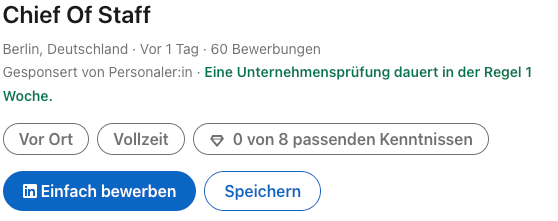
This forces hiring managers to use very rough heuristics to filter for candidate quality:
- Everybody who doesn’t have a master’s degree → out
- Everybody who didn’t go to a top5 business school → out
- Everybody who didn’t work at MBB (McKinsey, BCG, Bain) → out
This way, you end up with a subset of candidates that’s very likely not gonna suck.
But it also leaves out the high potentials, the ones who truly might make a difference.
And it leaves hiring managers in competition with everybody else who’s using the same rough heuristics.
So if you have a master’s degree from a top business schools and spent 2+ years at BCG, congratulations. You’re gonna get a lot of interviews.
But what do you do if that’s not the case for you?
Show, Don't Tell
I’m gonna blatantly steal the answer from Ben Lang: show, don’t tell.
Most applicants say they’re smart, driven, successful, etc. Very few of them display proof points for it.
Having graduated top 10% from a good business school is a proxy for “I’m smart”. It shows that you’re not an imbecile.
Having worked at MBB is a proxy for "I can work long hours and follow instructions". It shows you're not lazy.
We can use this “show, not tell” principle to improve your application in every aspect.
1 – Build your landing page
In most commercial roles, you will interface with clients, partners, talent sooner or later. If they wanna look you up, they will check LinkedIn.
It's also the first place a future employer would look.

If your LinkedIn isn’t spot-on, this is gonna be a bad start. So step 1 is to build out your social media profile.
Here's the 80/20:
- Write a catchy one-liner, describing how you can help companies. What also works is to simply put main signals as your one-liner (for me: TUM | ex-EF | Flix | Sdui | 760 GMAT or something like that). I personally hate the latter, but it appears to be working.
- Make sure your experience is up to date. Include 1-2 sentences about the results you’ve achieved there.
- Get a proper profile shot. No gym selfies.
- Use the banner – it’s free real estate.
- Start posting content. Once a week is fine. Write about your journey, your experiences, anything. Better to put something out there than nothing, unless it’s generationally terrible.
- Get to 500+ connections. Social signaling works.
- By all means, DO NOT use the #opentowork overlay. That just signals desperation. You don’t want to appear desperate.
This is baseline stuff. Boring, but necessary.
It shows that you’re a professional who can do the basics right and will be able to reach out to others.
2 – Gather Testimonials
This isn’t exactly showing, but having others tell about yourself is better than just saying it yourself. You can either use the LinkedIn feature, or use a dedicated solution like Senja.
Ask your former bosses and/or colleagues to give a short (2-3 sentence) statement about what it’s like working with you, what you’ve achieved.
Don’t fake it. Hiring managers might double check.
This is the first layer of social proof we’re adding to your application.
3 – Build your CV
Don’t do anything fancy here. Follow the classic guidelines. This article is a good place to start.
The job of a CV is to get you an interview, not to give a comprehensive overview about everything you’ve done. I personally like to add an “achievements” section where I feature impressive stuff I’ve done unrelated to my career.
Most importantly, though: show the results you’ve generated in your past work.
During my studies, I worked at Flixbus building their rental bus business froms scratch. Let's use this as an example:
- Bad: “worked on pricing for rental buses”
- Good: “developed the price prediction logic used to price bus rentals using a self-learning python model and multiple linear regression, leading to >10k instant quotes generated within a year at an ~11% profit margin.”
Everybody can do the work, not everybody can generate results. Make them tangible and quantifiable.
You can also link to your testimonials in your CV.
Also, please write your CV like a human. If I read "I'm a results-driven professional specializing in spearheading cross-functional initiatives to drive shareholder value" one more time, I'm gonna murder someone.
With those three out of the way, you’ve taken away most reasons for recruiters to instantly say “no”.
Now, it’s time to get them to say “yes”.
4 – Build Your Portfolio
These days, anyone can build products and websites. Yet I barely ever see them in applications.
If you’re on the job hunt, you have free time on your hands anyway. Use it. For example, you could:
- Build a mini-product that solves a very particular problem that you have. Examples: a website featuring all Magic: the Gathering tournaments in Berlin, a Cluster Headache Tracker, an app that charges your credit card for each time you snooze.
- Write online. Some of the best applicants I’ve seen have a blog where they share their thinking. This helps the hiring manager get a glimpse of the way that you operate. If you’re a good, concise writer, you’re probably also a good thinker.
- Publish videos. One applicant to Generalyst published this beautiful video explaining the Galois Theory (about symmetric polynomials). I have no idea what a symmetric polynomial is, but the sheer passion impressed both me and the hiring managers. Being passionate about something is cool. Needless to say, he got his internship.
If you build a mini-product, write 5 thoughtful blog posts and publish one well-executed video on YouTube – your chances of getting through the process increase massively.
5 – Reach Out Proactively
Every founder looks for candidates with bias for action. Some say they have it; others show it by simply reaching out to the hiring manager.
Research the person. Write a cold message referencing something about them (eg. something they’ve written), showing you’ve done your research. Have a specific ask. One of my favorites is: “considering applying to this position, are you still accepting new candidates?”. (This also helps eliminate ghost jobs.)
Showing your capability to write a good cold message is great.
But you can make it even better …
6 – Include Actual Work Product
Now, a good cold message is … good.
To truly push it over the top, you’d add a work product that you believe would be useful for the company. This shows:
- You’ve invested into the application
- The way you work
If you produce excellence here, then you should automatically get an interview. (This post recently popped up on my feed, and I think it’s a great example.)
A few examples:
- Writing a business case for a new product / expansion (I did this for my first interview at Flixbus back in the day and it worked like a charm)
- Doing a teardown of the careers page (if you feel like it could use improvement)
- Writing ad copy for a new ad for the existing business
- Outline the GTM approach you’d use to attack a new segment
This is the ultimate way of showing, not telling.
Plus, it eliminates the signaling problem from the beginning of the article: this way, you’ve shown that you are invested into the application.
How many other applicants would do this?
Now, let’s put it into practice.
Let’s say we wanted to get a job at Fonio, one of Austria’s hottest startups. Here’s what I’d do (not sponsored or anything, I just think they’re a cool company):
- Take a look at the careers page and see which position fits my profile best. In my case, that’d probably be GTM Manager for the US, as I’ve done a ton of international expansion and have lived in the US previously.
- First, I’d ensure that both LinkedIn and my CV reflects my experience, so that a quick screen confirms that I've actually done this.
- I’d also get my former CEO to write a quick testimonial about prior countries I’ve opened (eg. “We hired Dominik to build the entire international business for Sdui. He opened 7 markets for us, 5 of which we’re still active in – and today, the international business contributes significantly to our top-line growth.”) → This also gives a potential hiring manager an instant reference they can approach to verify.
With the baseline laid out, we can now begin working on the outreach:
- First, I’d research the founder. Daniel’s LinkedIn isn’t particularly insightful, but a quick ChatGPT query reveals that he’s very much a fan of bootstrapping. Great! I also bootstrapped a company before and am doing it again, so I can use that to relate and build trust. So my cold outreach message would read:
“Hey, saw your ad for a GTM Manager for the US market. Think we might get along - I’ve bootstrapped two businesses, lived in the US, and opened 7 markets for another scaleup. I put together a few pages on how I’d tackle the US market. Wanna see them?”
- This message is relatable, shows I’ve done my research, and already teases the work product. That we still need to create. It's also 249 characters.
- So next, I’d use the frameworks I’ve used for expansion before to put together a go-to-market plan: analysis, competitors, marketing mix, first wedges. Just a simple Notion page that outlines your thinking and further shows that you’ve researched the company. (Use your LLM of choice here to assist with the research - just like you’d do in the actual job.)
If he accepts the request – congrats, you’re in. Send over the doc.
If he doesn’t, don’t sweat it. Figure out his email, and try again. Grittiness sells, too.
Doing this took time, but you’ve just 10x’ed your chances of getting an interview.
(PS – in Fonio’s case, you can shortcut this process by simply applying to my company, Generalyst. We work together.)
Look, the job market is tough. I get it.
But this doesn’t mean you cannot have agency over your own fate.
Low agency people complain and continue to do the same thing, expecting different results.
High agency people take matters into their own hands and do whatever is necessary.
This is the recipe.
It’s up to you to execute it.
Have a wonderful week!
LFG.
Dominik
PS: is everybody doing this? NO! I’d estimate that one out of ~200 applications to Generalyst goes the extra mile. It’s really not that hard to stand out.
PPS: another article that might be valuable in this context – how to increase your market value.
Come say hi on socials:
LinkedIn | Threads | X | Bluesky | Instagram | TikTok | YouTube
Whenever you're ready, there are four ways I can help you:
[1] Reclaim up to 4 hours per day and find time to do the things you've always wanted to do by enrolling into Personal Productivity OS. (now only 29€ for lifetime access)
[2] Hire your next Founder's Associate or other business generalist position with my startup, Generalyst Recruiting.
[3] You could also find your next startup job in Europe by simply applying as a candidate.
[4] Learn how you can build your career as a generalist by subscribing to this newsletter. ⬇️

Dominik Nitsch Newsletter
Join the newsletter to receive the latest updates in your inbox.