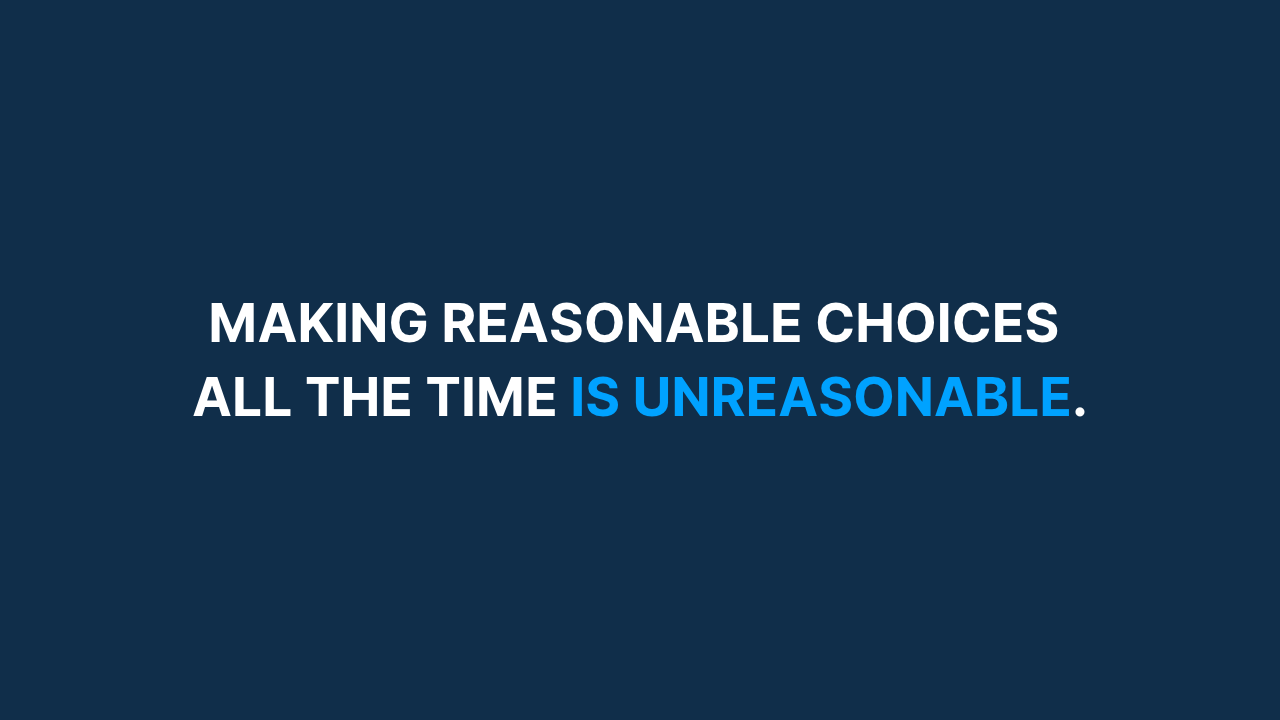
Making reasonable choices all the time is unreasonable
Why most people enter an MBA with high ambitions, and end up wanting to become a consultant.
I recently read an essay I just couldn't stop thinking about. It's called "I Teach at a Business School. It’s Time to Shut Them Down", written by Cambridge professor Christopher Marquis.
Specifically, this passage:
While some students appear to care only about their future compensation, I have met many with nobler goals: engineers who want to commercialize clean energy, physicians determined to fix the health care system, nonprofit leaders who have watched good missions fail for want of good management.
[...] But I’ve come to see how the institution can reshape the worldviews of those who enter it, often undermining the very ambitions that brought them there.
This change can take place in a single semester. Again and again, I have watched students abandon their altruistic intentions, instead becoming consumed by whether to choose careers in consulting or finance and who will land a summer internship at McKinsey or Goldman Sachs.
Curious, I thought. Surely few people pay the big bucks just to get a better consulting job? What happens inside an MBA that makes people … start thinking that way?
Then I remembered a reader submission.
(Context: in my onboarding email, I ask readers what they'd like to read about. If you run a newsletter, copy this. It's a never-ending fountain of inspiration.)
It reads:
"I have a lot of friends I love, none with my lifestyle, all high achievers (great university grades and career prospects), but almost no one with crazy ambitions, entrepreneurial drive or a clear idea of what they are giving up without a truly healthy lifestyle. This drives me down, especially during tough periods, and I have no idea how to tackle the situation emotionally and practically, besides kinda doing my own thing and ignoring the issue (if there is an issue at all)."
So: when do we lose the urge to do something that's truly meaningful to us, and start optimizing for safety instead?
Back to the MBAs.
How the ambition gets sanded off, one step at a time
The tallest flower gets cut down. Better to not stick out.
That's at least what Australians think when they talk about the tall poppy syndrome. I think it applies here, too.
At the beginning of an MBA, some people come in with grand ambitions. They wanna change the world. And I'd bet these people get hit with something along the lines of: "Ah c'mon man, be reasonable. Why not aim for something more achievable first?"
In the beginning, the ideas are all over the place. A wide distribution.
But slowly, steadily, the "reasonable" crowd gains traction. After all, "reasonable" is good. If you aim high, you might fail. Maximizing your odds of success seems like the more sensible choice.
You know, exactly like loving parents encouraging you to take the "safe" route because they - rightfully - don't want you to suffer.
Failing is bad, right? So if you can minimize the chances of failure, that's a good thing.
Over time, this opinion slowly takes over. And since you become the average of the five people you spend the most time with, and everybody else wants to be a consultant or banker, that's what you end up wanting too.
And there's more: these MBAs are expensive. You need an ROI on that spend, right? So why not go into a profession where you'll make a lot of money for sure? To prove it was worth it?
It's like people swearing AG1 works (an overpriced green powder where >50% of revenue is marketing spend) because they don't wanna look like fools who spent $79 a month on a bunch of nutrients they could get by eating … f**king vegetables.
Nobody wants to admit they made the wrong decision. So, instead of looking "stupid" for not getting ROI out of their shiny business degree, they'd much rather pay it off.
I certainly would have.
After my Bachelor's, I hatched a plan: work at a startup for a few months, take the GMAT, learn Swedish, train as a flight attendant, apply to SAS, then move to Stockholm for a Master's at the Stockholm School of Economics, with flying as my student job. (Genius move, trust me.)
I never made it past the GMAT step, because I joined a startup as a late co-founder. A decision that I'm very happy with.
But I did take the GMAT, and accidentally scored much higher than necessary for the schools I wanted to apply to (think: Harvard/Stanford territory; sharing my score here would feel like a bit too much bragging.) And after leaving that first startup, I was tempted to apply. Not gonna lie. Would've looked pretty fresh on a resume.
Then I thought again. Two hundred thousand dollars? Man, I could build a lot of startups with that kinda money. I decided against it.
Had I gone, I'm pretty sure I wouldn't have joined a company I could've joined without an MBA. I'd have wanted to do … MBA stuff. Consulting, banking, private equity.
Partly that's the sunk cost fallacy: you've put so much time and money in, you'd be a fool not to "use" it. And partly it's not a fallacy at all. If you took out a six-figure loan, the bank doesn't care about your dreams. They only care about you making enough money to pay it off.
So instead of you choosing your career freely, a choice you made years back now picks the career for you.
Not the right way to build a fulfilling career, if you ask me.
Playing it safe is the least safe thing you can do
- If you never do sports because you might get injured, you'll get injured the day you finally step onto the field.
- If you never ask anyone out because you might get rejected, you'll never learn how to handle a no.
- If you never build something on the side because you might lose your job, you'll be in real trouble the day you do lose it.
In the moment, the safe option is the easy choice. Maybe even the reasonable one.
But making reasonable choices all the time is unreasonable.
As Polish weightlifting legend Jerzy Gregorek says:
Easy choices, hard life.
Hard choices, easy life.
Yet somehow, playing it safe is the default. And when everybody plays it safe, it becomes average behavior.
You don't wanna be average. The average American is overweight, in debt, and likely to be divorced.
If you let your degree and your peers design your career, you will get some social currency (status, wealth). But ultimately, that's not what counts.
What actually counts
In my mind, the highest status symbol there is: waking up every morning feeling like a kid on their birthday, ready to tackle the day, excited to work on the things you've lined up.
This is highly individual. Figuring it out is hard. Which is why it passes the earned-status test: you can't just wake up one day and buy meaning.
And meaning looks wildly different for different people. Some people need to settle Mars to feel something. Others, like the wonderful Croatian cleaning lady I had in Frankfurt, find it in the most ordinary things. In her case: cleaning apartments.
"It's tangible," she told me. "I show up, the apartment looks like s**t [arguably true], I clean, it looks great."
She'd been doing it for 20 years at that point. I hope she's still at it.
Titles didn't matter to her. What mattered was seeing the result of her work at the end of the day.
What matters to you might be completely different, but I imagine increasing shareholder value isn't it.
So what do you do about it?
Taking the wrong path isn't a problem. Never noticing and not course-correcting is. Because if you don't course-correct early enough, you will deviate so much from your path that it'll be impossible to get back to it.
Just like an airplane flying out of Berlin following a course that's just off by 1° will end up in Philadelphia instead of NYC.
Now, imagine you don't just do this for a few hours but for your entire life and yeah ... you get the idea.
Which brings me back to the reader.
Your friends aren't the problem. They're optimizing for what they were taught to optimize for: safety, prestige, a payoff on what they already put in.
I don't think that's a character flaw. It's just their default setting.
You, on the other hand, took the big step to challenge your default settings. Hell yeah.
So don't try to convert them. And don't ignore it either. Do two things:
- Keep the friends, but add new peers. Your friends don't have to share your ambitions. But you need some people around you who do. Find the ones building things on the side, the ones who left the safe track, the ones who'll get excited instead of saying "be reasonable." Like, the ones who apply to Generalyst.
- Let your results do the talking. Difficult to win an argument over dinner. Easier to win it in five years, when you wake up like a kid on their birthday and they're asking how you did it.
They're making easy choices.
You're making the hard ones.
Keep doing that.
If you enjoyed this article, follow me on the social channels of your choice:
LinkedIn | Threads | X | Bluesky | Instagram | TikTok | YouTube
Whenever you're ready, there are four ways I can help you:
[1] Reclaim up to 4 hours per day and find time to do the things you've always wanted to do by enrolling into Personal Productivity OS.
[2] Hire your next Founder's Associate or other business generalist position with my startup, Generalyst Recruiting.
[3] You could also find your next startup job in Europe by simply applying as a candidate.
[4] Learn how you can build your career as a generalist by subscribing to this newsletter. ⬇️

Dominik Nitsch Newsletter
Join the newsletter to receive the latest updates in your inbox.